
Data protection and ethics in research
Research with and on humans requires a high degree of ethical and legal responsibility. The protection of personal data serves not only to comply with rules, but above all to respect the rights, dignity and privacy of the participants - especially in the case of sensitive information, for example in medical or psychological research.
Research projects are therefore reviewed by ethics committees to ensure that both the handling of data and the protection of the people involved are appropriately regulated. Responsible data protection not only protects the participants, but also the researchers themselves by creating trust and reducing risks.
The aim of this page is to provide a clear overview, offer guidance and provide practical assistance for day-to-day research.

Researchers, students, project managers - especially for research with/on people
Contact persons for data protection and information security at KIT
MORE INFORMATIONData protection in the ethics application procedure
MORE INFORMATIONBasic principles of research ethics
The handling of personal data in research touches on fundamental ethical values. Beyond mere legal permissibility, the decisive factor is whether a research project is designed responsibly. The following ethical principles provide central guidance:
1. Social or scientific value
The research question must pursue scientific value. The improvement of health, well-being, or the advancement of knowledge are central objectives.
2. Scientific validity
A study must be conducted according to recognized scientific principles and methods so that the results are reliable and meaningful.
3. Fair selection of study participants
Participants should be selected fairly, without disadvantaging or exploiting certain groups, especially vulnerable individuals.
4. Favorable risk–benefit ratio
The potential risks for participants must be minimized and proportionate to the expected benefits.
5. Independent review
The study must be reviewed by an independent body to avoid conflicts of interest and ensure compliance with ethical standards.
6. Informed consent
Participants must be fully informed about the purpose, procedures, risks, and alternatives so that they can make a voluntary and informed decision.
7. Respect for study participants
The rights and welfare of participants must be respected at all times, in particular through the possibility of withdrawal, protection of privacy, and information about relevant new findings.
Basic principles of data protection
The processing of personal data is subject to fundamental principles of data protection law. The processing of personal data is generally prohibited unless it is permitted by a legal basis or effective consent.
The General Data Protection Regulation (Art. 5 DSGVO) defines the central principles, which are also binding in a scientific context. In addition, it requires, among other things, data protection through technology design ("privacy by design") and extended information obligations towards data subjects.
1. Lawfulness and transparency
Any processing of personal data requires a clear legal basis. In addition, data subjects must be able to understand which data is processed, for which purpose, and on what legal basis.
2. Purpose limitation
Data may only be collected for clearly defined and legitimate purposes. Subsequent use for other purposes not originally intended is generally not permitted.
3. Data minimization
Only personal data that is necessary for the respective research project may be collected. The collection of data "on reserve" contradicts this principle.
4. Accuracy
Personal data must be factually correct and, where necessary, up to date. Inaccurate data must be corrected or deleted.
5. Storage limitation
Data may not be stored indefinitely. As soon as it is no longer required for the intended purpose, it must be deleted or, if possible, anonymized, provided that there are no legal obligations to retain it.
6. Integrity and confidentiality
Suitable technical and organizational measures must be taken to ensure that personal data is protected against unauthorized access, loss, or manipulation.
7. Accountability
The controller must be able to demonstrate that it complies with these principles. Data protection must therefore not only be implemented, but also documented.
Overlaps
In the area of informed consent and respect for study participants, there is a particularly clear overlap with legal requirements for proper data protection. Both principles require that personal data is only processed on a lawful basis and that data subjects are fully informed about the type, purpose and scope of data processing.
Informed consent is not only an ethical requirement, but also a legal one. It must comply with the applicable data protection regulations, particularly with regard to transparency, voluntariness and comprehensibility. This requires sound legal knowledge in order to ensure that declarations of consent comply with current statutory provisions and case law.
Respect for (potential) study participants is also closely linked to legal protection mechanisms. Aspects such as the right to withdraw consent, the protection of privacy, the guarantee of confidentiality and information about new findings are both ethically required and legally regulated.
Against this background, it is important for researchers to familiarize themselves with the legal situation or seek legal advice and to continuously adapt research projects to the applicable legal situation. The overlap between ethical and legal requirements makes it clear that responsible research requires an interplay between scientific objectives and ethical principles.
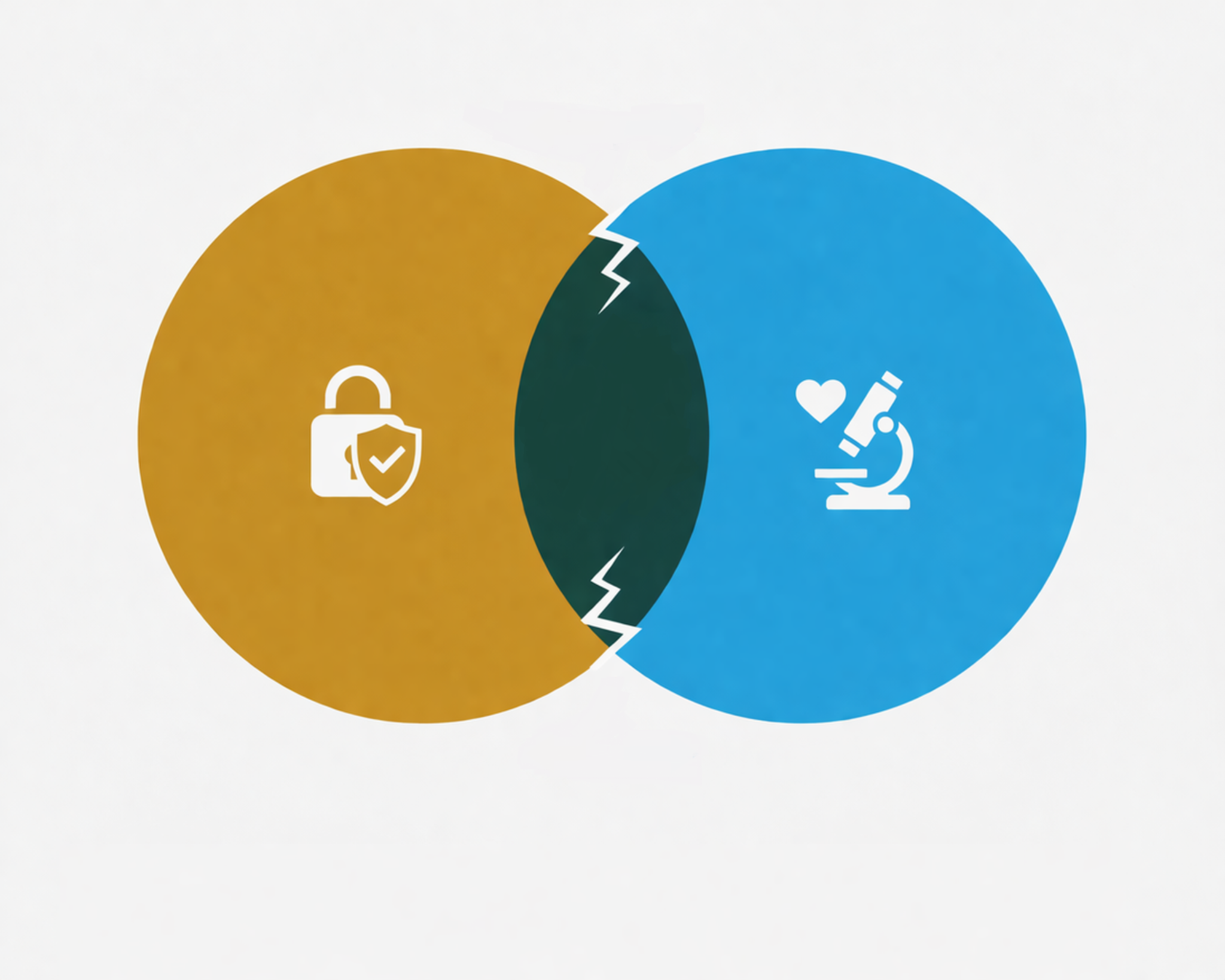
Areas of tension
The ethical principles of research ethics are closely related to the principles of data protection law regarding the processing of personal data. Both approaches pursue the goal of protecting the rights and well-being of data subjects. In the practical implementation of research projects, however, areas of tension can arise, as scientific interests, technical possibilities and protection requirements sometimes pose different demands.
A key tension exists between open science and the principle of purpose limitation under data protection law. While open science promotes the freest possible reuse of data, data protection requires clear purpose limitation.
Example: Data from a study is intended to be shared publicly at a later date, even though consent applies only to the original use.
The principle of care can also conflict with data protection requirements. Researchers wish to inform participants about results or contact them for follow-up studies, while at the same time there are obligations to delete data.
Example: Contact information is deleted, even though participants would have liked to be informed about the results.
The principle of data minimization often clashes with the scientific interest in having the most comprehensive datasets possible for multiple uses.
Example: Additional data is collected that is not strictly necessary for the specific research question but is intended to enable future analyses.
The right to withdraw consent adds another layer of complexity. Participants can withdraw their consent, which, however, can impair the long-term use and stability of datasets.
Example: Personal data that has been published and downloaded can no longer be removed upon revocation.
Collaboration with third-party providers can raise questions of data autonomy and trust, particularly regarding sensitive data such as health information.
Example: Health data is processed via external cloud services, which causes uncertainty among participants.
The voluntary nature of participation is also not always clear. Incentives must not unduly influence the decision, while fair compensation arrangements—even in the event of withdrawal—must be established.
Example: High compensation could pressure participants to join, or withdrawal provisions could lead to conflicts.
Finally, practical questions of care and responsibility arise, particularly regarding information security or data protection jurisdiction.
Example: In student projects, it is often unclear who formally bears responsibility for data protection.
Legal basis
The processing of personal data in research is subject to clear legal requirements. The respective state data protection laws, the State Higher Education Acts (LHG), the General Data Protection Regulation (GDPR) and other subject-specific regulations are decisive.
General Data Protection Regulation (GDPR)
The GDPR forms the Europe-wide basis for the protection of personal data. It regulates the lawfulness of processing, the rights of data subjects and special requirements for research projects.
State Data Protection Act (Baden-Württemberg)
The state data protection laws specify the data protection requirements for public bodies and universities in the respective state. They contain supplementary regulations on the processing of personal data in the higher education sector.
State Higher Education Act (LHG)
The State Higher Education Act regulates the tasks and powers of universities in the respective federal state and forms the institutional framework for research and data processing.